
Football has moved on. Broadcasting can.
Last week we measured how the main camera squeezes the far side of the pitch. This week, the fix. It isn't a taller camera 1. It's a small system around it: four cameras that look along the wings, a main camera on each side, a cable camera used live, and a tracking layer for the players off screen. Here is what each one adds, measured with the same camera model, and how to test what audiences will accept.
Why not just raise camera 1?
The obvious fix is a taller camera 1. Part one showed that a 30 m gantry would give about 2.5 times today's far-wing detail, for every shot, with no change to the familiar view. That is a real gain. This summer's World Cup showed what it costs. Many venues were built for American football, so camera positions sat significantly higher than in European grounds, and some viewers said the picture felt further from the action. Players looked smaller. Fans felt less connected to the game.
Height also leaves the other half of the problem untouched. Much of what decides a match happens away from the ball: the runs, the decoys, the shape of the back line. Rugby has exactly the same gap. No single camera, at any height, shows all of that.
Raise one camera and you trade connection for context. The fix is to stop asking one camera to do two jobs.
One camera, two jobs
Camera 1 looks across the pitch. That makes it excellent at showing progress up the pitch, which it draws at full scale, and poor at showing width on the far side, which it draws at about a ninth of that scale.
A camera that looks along the pitch does the opposite. It draws width at full scale and compresses progress. Neither view is wrong. They are two halves of the same picture, and live football has only ever used one of them.
Tennis and cricket settled this long ago: their main cameras look end-on, along the line of play. Football has the problem in both directions at once. So it needs both views, and a way of moving between them that viewers can follow.
Four additions around camera 1
Four channel cameras
One behind each byline on each side of the goal, level with the midpoint between the goal and the touchline, about 20 m up. Each looks straight down a wing channel. When play settles in that channel in that half, during wide build-up, an overlapping run or a cross, the director cuts to it.
On the far wing in the half nearest it, it lifts the weakest on-screen direction from 5.7 to 17.9 pixels per metre, about three times today's camera, and cuts the grass hidden behind a player from 18 m to under 5 m. Width itself goes from 14 to 45 pixels per metre. It is a channel camera, not a main camera: at the halfway line, 72 m away, its depth detail drops to 13.5 pixels per metre, and showing progress up the pitch stays camera 1's job.
End-on cameras are already part of the furniture. UEFA's Champions League rules require a high camera behind each goal, aligned with the centre of the pitch. This proposal keeps those and adds four more out in the channels, subject to a survey of each ground for platforms, sightlines and approval.
A main camera on each side
UEFA's Champions League rules already require a reverse-angle camera in the opposite stand, aligned with the centre of the pitch and no higher than the main cameras. Make it a full main camera and switch to it when play moves to the far touchline, so the active wing is always the near one.
At today's height that alone gives about 1.5 times the far-wing detail. Level with halfway, the point part one measured, it goes from 6.9 to 10.1 pixels per metre and the hidden strip shrinks from 17 m to 10 m. In the attacking half, the point used in the table below, it goes from 5.7 to 8.3. Play on that wing is also 55 m from the camera instead of 92 m, so the players look bigger at the same zoom. On paper, that addresses the World Cup problem: more context and more connection, not one at the expense of the other. One practical catch: UEFA asks for main cameras to face away from the setting sun, so the opposite side will need care at some grounds and kick-off times.
The cable camera, used live
Spidercam has been in the Premier League since Sky rigged one at Old Trafford in January 2017, but it has rarely been used as the main live angle. Hung 20 m up behind play, it gives the most even picture of all: 22.8 pixels per metre in its weakest direction on the far wing, around three to four times today, with almost nothing hidden behind players.
Its limits are real. Sky's 2017 rig was reported to travel at up to 20 miles per hour, slower than a winger at full sprint and far slower than a driven pass. When NBC tried American football from its Skycam, its executive producer noted that the ball is always moving away from the camera. So the cable camera belongs in settled attacks, set pieces and the first seconds after a restart, not in every counter-attack.
A tracking layer for the players you can't see
Premier League grounds now use up to 30 tracking cameras to follow the ball and every player for semi-automated offside. One study of broadcast footage found a typical main-camera frame shows only 10 to 16 of them. A small radar on demand, drawn from that tracking data, would put the rest back on screen: the dummy runs and defensive shape that never make the frame.
There is interest in this kind of view. The BBC's interactive 3D match experience, built from tracking data, had almost five million views across this summer's World Cup.
Same moment, four views
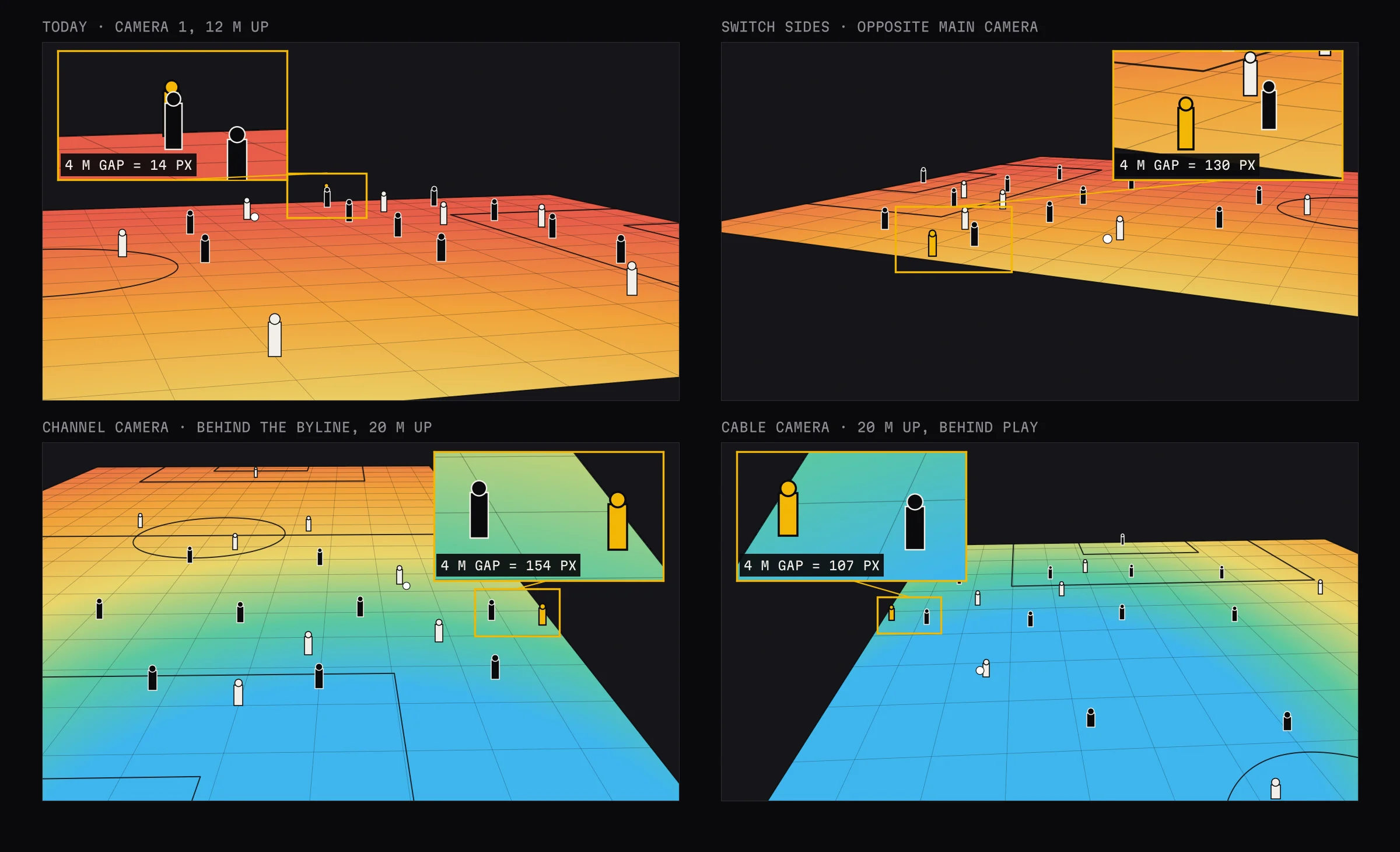
Here is one moment, an overlapping full-back on the far touchline, from four of those cameras. Every view is framed on the same patch of grass. The full-back, in yellow, is 4 m from the defender marking him.
 50% or more of each metre kept
From camera 1 the gap is 14 pixels and the full-back is half hidden behind the defender. From the opposite main camera it is 130 pixels, from the cable camera 107 and from the channel camera 154. The opposite and channel views make the players bigger too: a standing player is 57 pixels tall in today's view, 77 from the opposite main camera and 63 from the channel camera. The cable camera draws them smaller, at 45 pixels, because it needs a wider lens to take in the same patch from behind play.
These are modelled gains in what reaches the screen. Whether viewers read the game better as a result is what a trial has to show.
| Camera | Weakest direction, far wing | Grass hidden behind a player | Best used for |
|---|---|---|---|
| Camera 1 today, 12 m up | 5.7 px per m | 17.6 m | Midfield, transitions, anything fast |
| Camera 1 raised to 30 m | 14.0 px per m (2.4×) | 6.2 m | Everything, but every shot looks further away |
| Opposite main camera, 12 m up | 8.3 px per m (1.5×) | 11.0 m | Play on the far touchline, after a stoppage |
| Channel camera, 20 m up | 17.9 px per m (3.1×) | 4.7 m | Wide build-up, overlaps, crosses |
| Cable camera, 20 m up behind play | 22.8 px per m (4.0×) | 2.5 m | Settled attacks, set pieces, restarts |
Each camera frames a 30 by 30 m patch of the far wing in the attacking half, centred 15 m in from the far touchline, in a 1080-line picture. The weakest direction is the way across the grass that the camera shows worst. Hidden grass is the strip behind a 1.85 m player that the camera cannot see.
Can viewers cope with crossing the line?
Broadcasters keep every live camera on one side for a good reason. Crossing the line flips left and right on screen, and a sudden flip disorientates. Film-makers cross it with a moving shot or a clear signal, which is why sport labels its reverse angles. Switching the main camera mid-match is a bigger ask, and the evidence on appetite is mixed but encouraging.
- Cricket
When World Series Cricket put cameras at both ends in 1977, viewers complained of being disorientated. Today every broadcaster moves the main camera to the bowler's end each over, as standard.
- American football
When fog forced NBC to show most of a game from Skycam in 2017, the reaction was mostly positive. A planned full game from Skycam a month later drew a range of reactions, and a study of almost 500 viewers found neither angle helped people judge yardage better, and regular players of the Madden video game did worse on running plays from the high angle.
- Football
Sky's Game Mode, a high moving camera shown on a separate channel, divided fans in 2023 and again in 2024. The BBC's opt-in 3D experience drew almost five million views at the World Cup.
None of this proves how football viewers would react. But the precedents point the same way: a new view seems to land better when viewers can predict it or choose it, and worse when it is sprung on them. That is a hypothesis worth testing, and it suggests a simple starting rule for switching sides: never cross the line while the ball is moving.
Football gives directors plenty of chances to do it cleanly. Opta counted about 95 stoppages a game early last season, and over the season there were 13,615 throw-ins, about 36 a game. When the ball goes out on the far side, the restart is shown from the opposite main camera with a direction marker on screen. At the next stoppage after play comes back, the picture switches back.
The director's new rule book
- The principle
Keep the familiar view when play is fast or unpredictable. Bring in another angle only when it clearly shows more, and make every change of direction predictable.
- Camera 1
Stays the anchor: midfield, transitions and anything fast.
- Channel cameras
When play settles in a wide channel in the attacking half, cut to that channel's camera. Never in a fast transition.
- Opposite main
When the ball goes out on the far touchline, restart from the opposite side with an on-screen direction marker. Switch back at the next stoppage.
- Cable camera
Live for set pieces, settled attacks and the first seconds after a restart.
- Tracking radar
On demand, never forced.
- The one rule
Never cross the line while the ball is moving.
How to test it
None of this should go straight onto the main feed. It should be tested in stages, so each gain can be pinned to one change rather than a bundle of them.
- Stage 1
Re-edit recorded matches. Rebuild selected passages from the reverse-angle, behind-goal and cable camera feeds that already exist, and compare them with what was broadcast. No new kit.
- Stage 2
The opposite main camera, live, with the stoppage rule and a direction marker. Measure how quickly viewers reorient.
- Stage 3
Channel cameras on temporary platforms at one suitable ground, tested on wide build-up, overlaps and crosses.
- Stage 4
The full system: one match produced twice, with viewers randomly assigned to the standard or full-pitch feed.
Measure both sides of the ledger. The gains: whether viewers spot passing options, off-ball runs and defensive spacing, and how connected they feel to the game. The costs: disorientation, missed action, directing errors and how often viewers still prefer the standard view.
What a broadcaster would actually need
Four channel platforms, surveyed and approved ground by ground. A camera, lens and operator or remote head for each, plus shading, talkback, signal routing and vision-mixer inputs. An opposite main camera matched to camera 1 as a true programme camera. A cable camera rig where the roof allows it. And a director working to new rules. That is more than an extra camera or two, which is why the staged trial matters, and why stage 1 costs almost nothing.
The kit is the easy part. The single-side main camera has been the convention since the BBC began televising football in the late 1930s, and conventions are harder to move than cameras.
The idea is ready. Now test it.
Camera 1 does one job brilliantly. The far side of the pitch needs a second view. The first stage of the test needs no new kit, only footage that already exists. If you are a broadcaster, league or production partner who wants to run it, we would like to hear from you.
Read part one: the far touchline problemTo talk about a trial, email hello@myomyproductions.com
All figures come from the pinhole camera model calibrated on the ITV1 broadcast of England v Croatia at Wembley (see part one), on a 105 by 68 m pitch, for a 1920 by 1080 picture. Coordinates run from the centre spot: x along the pitch, y across it with the near touchline at −34 m, z up.
Camera positions: camera 1 at (0, −72.5, 11.8); opposite main camera at (0, 72.5, 11.8); channel cameras at (±72.5, ±17, 20), 20 m behind each goal line and 17 m in from each touchline; cable camera 20 m up and 25 m behind play; raised camera 1 at (0, −72.5, 30). At 15 to 30 m up and 10 to 30 m back, the channel camera's far-wing gain ranges from about 2 to 4.5 times today.
Table and text figures: each camera is aimed at the point being measured and zoomed so a 30 by 30 m patch around it fills the frame. The attacking-half point is (26, 19); the halfway point used in part one is (0, 19). The weakest direction is the smaller singular value of the ground-to-screen scale at that point, in pixels per metre. Hidden grass is the strip behind a 1.85 m player that the camera cannot see.
The four-view scene uses invented player positions, not tracking data. Every view is zoomed to fit the same 38 by 32 m area, wider than the table's patch, and the full-back and his marker stand near the far touchline, at (28, 33) and (27, 29). There, camera 1 gives about 3.5 pixels per metre in the direction of their gap, so 4.1 m becomes 14 pixels. Gaps are measured between the two players' feet. No broadcast frames are reproduced.
- Poor picture quality at the World Cup? Here's why, blue News
- UEFA Champions League regulations 2026/27, Annex E camera positions
- UEFA Champions League regulations, E.2.8 Reverse-angle cameras
- Spidercam debuts at Man United v Liverpool, SVG Europe
- Spidercam top speed, Prolific North
- Why the Madden view won't take over NFL broadcasts, ESPN
- Semi-automated offside technology, Premier League
- Off-screen player imputation for broadcast football analytics, arXiv
- BBC hits 15.8m peak for World Cup final, Broadcast
- The 180 degree rule, SFU Media Lab
- The tentacles of TV, ESPNcricinfo
- It's better from behind the stumps, ESPNcricinfo
- Skycam, Wikipedia
- NFL fans and NBC's high Skycam, BroBible
- NFL yardage estimates by camera angle, University of Florida
- Sky Sports Game Mode divides fans, SPORTbible (2023)
- Game Mode at Arsenal v Brentford, SPORTbible (2024)
- Premier League delays and stoppages, Opta Analyst
- Five trends from 2026/27, Premier League
- English football on television, Wikipedia