
Football has moved on. Broadcasting hasn't.
The main television camera at a football match shows one half of the pitch well and squeezes the other. Measured from a Wembley broadcast, a metre of grass across the far side gets about a ninth of the screen space of a metre along it. That is enough to follow the ball up the pitch. It is not enough to read width, spacing or the runs the modern game is built on.
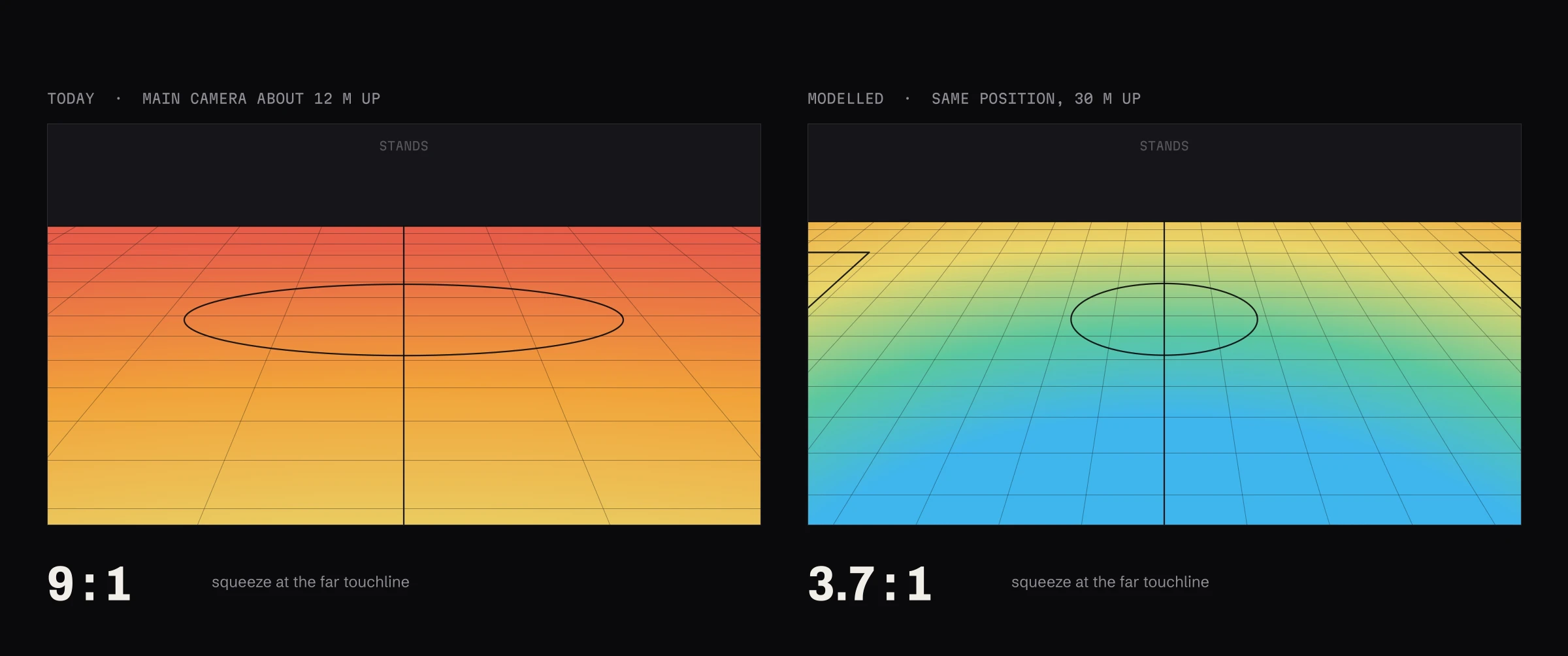
 50% or more of each metre kept
The game you don't see
Have you ever watched a match in the stadium, then seen it on television and wondered if it was the same game? A full-back who ran the game looks anonymous. A passing option you saw clearly never seems to exist. A winger appears to be standing on his marker.
Some of that is the commentary and the edit. Some of it is decided before kick-off, by where the main camera stands. This piece measures what that camera can and cannot show, using real broadcast frames. It then asks why football coverage has changed so little while the game it shows has changed so much.
One camera carries the game
Live football is built around camera 1: a wide shot from a platform near the halfway line, panning to follow the ball. Close-ups, reverse angles and specialist cameras are mostly used for replays, stoppages and reactions. While the ball is in play, the director stays wide.
Camera 1 is estimated to provide 60 to 70% of the programme pictures in a live match. That is despite the choice available: a Premier League production typically uses at least 20 cameras, drawn from a camera plan of 41 positions.
The game itself is now measured in full. Every Premier League ground has up to 30 tracking cameras for semi-automated offside, following the ball and all 22 players at 10,000 points each. Viewers still get the game mostly through one camera, which shows 10 to 16 of the 22 players in a typical frame.
So camera 1's geometry matters more than any other camera's.
What we measured at Wembley
The case study uses eight photographs of the ITV1 broadcast of England v Croatia in the UEFA Nations League at Wembley on 12 November 2026. A pitch is a ruler with known markings. The touchlines, halfway line and centre circle sit at fixed distances, so where they fall in a frame reveals where the camera must be.
We fitted a standard camera model (height, distance, focal length and tilt) to the markings in one clear wide frame. We then checked it against eleven measurements of the centre circle that the fit had not used. The model predicted them to within 2%.
| Quantity | Estimate | Plausible range |
|---|---|---|
| Camera height above the pitch | 11.8 m | 9.9 to 14.6 m |
| Distance behind the near touchline | 38 m | 26 to 57 m |
| Angle down to the far touchline | 6.3° | 6.0 to 6.7° |
| Angle down to the centre spot | 9.3° | 8.7 to 9.8° |
| Angle down to the near touchline | 17.1° |
Height and distance trade off against each other, so each has a wide range on its own. The viewing angles are tightly fixed, and the angles are what decide how the pitch looks. These are estimates from broadcast frames, not a surveyed camera position.
The squeeze, explained
A camera looking down at a shallow angle sees ground running away from it foreshortened. A metre along the touchline keeps its full width on screen. A metre across the pitch, away from the camera, shrinks by roughly the sine of the viewing angle. At 6.3° that factor is about one ninth.
In the measured wide shot the far half of the pitch fills 22% of the picture height. The visible part of the near half fills 52%, and the stands take the remaining 26%.
What that looks like at home
On a 55-inch television watched from 2.5 metres, a 2 m gap between two players on the far side is 6 mm on screen if it runs across the pitch, and 56 mm if it runs along it. A sprint at 7 m/s crosses the screen at 2.2 cm a second one way and 19.5 cm the other.
Six millimetres is still visible. But a one-metre change in that gap, the difference between a player being free and being marked, is a change of 3 mm.
Players hide grass
A camera this low also loses ground behind each player. A 1.85 m player on the far touchline hides about 20 m of grass behind him. Fifteen metres in from that line the hidden strip is 17 m, at the centre circle 13 m, and on the near touchline 7 m. A run made behind a far-side player can disappear altogether.
The result is a picture that tracks progress up the pitch well, because that direction is drawn at full scale. It shows width, spacing and movement across the far side at around a ninth of that scale.
Why the stadium sees a different game
A supporter in Wembley's upper tier, roughly 35 m up and 60 m back from the near touchline, looks down at the far touchline at about 15°. Their squeeze is about 4 to 1, not 9 to 1. They also choose where to look, so they can watch the full-back's run while the ball is still in midfield.
That may explain why fans in the ground and viewers at home often judge the same player differently. Wide players and full-backs on the far side do much of their work in the direction the camera compresses most. This is a hypothesis, not yet a finding, and it can be tested.
How football compares
Football does not lack cameras. What sets it apart is how little the main live view has changed, while the game itself has become one of space, structure and data.
The biggest football competitions
| Competition | Cameras per match | Main live view |
|---|---|---|
| World Cup 2026 | 45 at all 104 matches, including pole cams, cable cams, cine-style cameras and 360 rigs | Camera 1. RefCam at every match was a World Cup first |
| Bundesliga | At least 16; 28 for the Saturday evening flagship | Camera 1. A moving main camera on a 70 m roof track went into the world feed in a January 2025 trial |
| LaLiga | At least 18, more than 32 at bigger matches | Camera 1. Cinematic cameras used live since 2021 |
| Premier League | At least 20, from a plan of 41 positions, plus up to 30 tracking cameras for offside | Camera 1. Polecams, roaming cameras and RefCam added for 2025-26 |
The Premier League has the most money of the four. Its domestic deal is worth £1.675 billion a season, around double the domestic rights in Germany, Spain or Italy. Its 2025-26 broadcast changes were mostly about access: substitute interviews, pitch access for celebrations and limited dressing-room filming. The main picture itself was tested once, when Sky's Game Mode replaced camera 1 on an alternative channel for Arsenal v Manchester City in October 2023. Neither that nor the Bundesliga trial has become the standard view.
Other premium sports
| Sport | Example coverage | Where the live picture comes from |
|---|---|---|
| Formula 1 | About 25 track cameras and 90+ onboard | Specialist cameras throughout. Every driver's onboard can be picked live |
| NFL | Super Bowl LX: 145 cameras, 81 for the game, two Skycams | High sideline camera for each play, specialist angles between plays |
| Tennis | Wimbledon: 165+ host cameras, 29 on Centre Court | High camera behind the baseline, looking down the court |
| Golf | 2025 Ryder Cup: three drones and a plane, tracing on every tee | Many cameras by necessity; drones and tracing show ball flight live |
| Cricket | 2025 World Test Championship final: at least 48 cameras, Spidercam and a drone | Camera behind the bowler's arm, switching ends each over |
| Rugby union | 2015 World Cup: at least 30 per ground, 40 at key stadia, ref cam at every game | Side-on main camera like football, with ref cam, line-out and corner cameras |
Three things set football apart. It does not stop. Other sports break every few seconds or minutes, and those breaks are where specialist angles get shown. Football gives a director 45 minutes of continuous play, so the main camera carries it.
Its main view looks across the play. Tennis and cricket look end-on, so the squeezed direction is not the one that matters most. Football's camera 1 looks across the pitch, so on the far side the squeezed direction is width and spacing.
Its new cameras serve the edges. RefCam, polecams, cine cameras and cable cams mostly feed replays, emotion and access. Football's camera count is in line with rugby and cricket and below the NFL and Wimbledon. What has not moved is the main view.
What the standards say
UEFA's Champions League regulations ask for main cameras on the halfway line looking down at 12 to 15° to the centre spot. Our Wembley estimate is 9.3°. That is not proof of a breach: the match was a Nations League fixture, not a club competition, and the rule is framed as a principle. But it suggests the camera sits below the angle UEFA itself prefers.
Keeping the camera the same distance from the pitch, this is what each angle needs:
| Camera | Height | Angle to centre spot | Angle to far touchline | Far-side squeeze |
|---|---|---|---|---|
| Wembley estimate | 11.8 m | 9.3° | 6.3° | 9.0 to 1 |
| UEFA, lower limit | 15.4 m | 12° | 8.2° | 7.0 to 1 |
| UEFA, upper limit | 19.4 m | 15° | 10.3° | 5.6 to 1 |
| 12° to the far touchline | 22.6 m | 17.3° | 12° | 4.8 to 1 |
| Roof gantry | 30 m | 22.5° | 15.7° | 3.7 to 1 |
Even at UEFA's preferred angles the far side stays heavily squeezed. The standard is written for the centre of the pitch. Nothing in it sets a minimum for the far touchline, where wide play happens.
Resolution does not fix this. UK HD channels broadcast at 1080i, and at normal living-room distances most viewers sit too far away to see UHD's extra detail. More pixels spread across a squeezed strip of grass still leave it squeezed. A better angle helps every viewer on every screen.
What would change it
We modelled alternative positions with the same calibrated camera. Each frames the same 30 by 30 m area of the far wing, centred 15 m in from the far touchline, and we measured the weakest direction on screen: how many pixels a metre of movement gets in the direction that camera shows worst.
Height is the strongest single lever. A 30 m halfway camera gives about 2.5 times today's far-wing detail and keeps the familiar left-to-right view. Corners help less than they look. They balance the two pitch directions, but their weakest direction becomes the diagonal. A cable camera behind play gives the most even picture of all, which is why it suits replays and tactical feeds.
Crossing the line
Football keeps every live camera on one side of the pitch, so left and right never swap on screen. This is the 180-degree rule, and it is why reverse angles are kept for replays. With a main camera on each side, a director could always show wide play from the nearer touchline, so the active wing is never the squeezed one.
The rule made sense when television was new. Is today's audience savvy enough to handle crossing it? Viewers already accept the direction of play flipping at half-time. Cricket faced the same question in 1977, when viewers complained of being disorientated by looking down the pitch from a new end every over. Kerry Packer installed cameras at both ends anyway, and cricket still switches its main view with the bowler. A clear on-screen cue at each switch may be all football needs.
A tactical feed
The cheapest step needs no new platform. A high wide view, offered as a second live stream, lets viewers choose. Sky ran this idea with Game Mode in 2023, and BBC Sport offered interactive 3D viewpoints at the 2026 World Cup.
What we know, and what needs testing
- Measured
The main camera at this broadcast looks down at the far touchline at about 6°. Movement across the far side is drawn at about a ninth of its scale along the pitch, and the far half of the pitch gets a fifth of the picture.
- Estimated
The camera's exact height and distance, camera 1's exact share of live play, estimated at 60 to 70%, and the gains from other positions. A site survey, a full match log and a live trial would firm each one up.
- Not yet shown
That a better angle makes viewers understand the game better. Geometry says the information is on screen; only a viewer study can say people use it. Show the same passages of play from today's camera and from a higher one, then ask fans and coaches to judge spacing, runs and passing options.
Football has moved on. Broadcasting hasn't, yet.
Clubs track every player many times a second, and analysts talk about rest defence, half-spaces and the width of a back line. The main television picture still shows most of that width at a ninth of its scale. The technology to show it properly already exists. What is missing is the decision to use it on the picture people actually watch.
Request the technical paperhello@myomyproductions.com
Next: part two sets out the cameras that would fix it.
Pitch assumed at Wembley's 105 by 68 m. Camera modelled as a pinhole with four unknowns (height, distance, focal length, tilt), fitted to pitch markings in one wide frame and checked against eleven independent centre-circle measurements, with errors between −1.9% and +0.2%. Ranges come from varying the fit within measurement error. Alternative positions use the same lens model and framing rules and are not on-site tests. No broadcast frames are reproduced; every graphic is drawn from the camera model.
- UEFA Champions League regulations, E.2.1 Main cameras
- How FIFA plans to broadcast 104 matches, Indian Television
- World Cup 2026: the firsts, SVG Europe
- Inside the DFL's camera concepts, SVG Europe
- DFL trials moving main camera, SVG
- LaLiga camera angles, SVG Europe
- LaLiga cinematic camera, SVG
- Directing a Premier League match, SVG
- Premier League £6.7bn domestic deal, Inside World Football
- Premier League 2025-26 broadcast changes, Goal
- Game Mode trial, Premier League
- World Cup 3D Experience, BBC Sport
- F1 broadcast facts and figures, SVG Europe
- Sky Sports 2026 F1 coverage
- Super Bowl LX by the numbers, Newscast Studio
- Super Bowl LX cameras, TV Technology
- Broadcast history and strategy, Wimbledon
- How Wimbledon covers the live match, SVG Europe
- Ryder Cup 2025 production, SVG
- World Test Championship final 2025 broadcast, ICC
- Rugby World Cup 2015 coverage, Mail on Sunday
- Rugby World Cup 2015 host broadcast, SVG Europe
- The tentacles of TV, ESPNcricinfo
- Cricket's two primary cameras, ESPNcricinfo
- List of HD channels in the UK
- BBC survey on UHD viewing distance, informitv
- Premier League camera plan, LEMO
- Semi-automated offside technology, Premier League
- Semi-automated offside explained, ESPN
- Off-screen player imputation for broadcast football analytics, arXiv